What Is an Agentic Automation Platform for Audit and Finance?
.png?width=1400&quality=90&format=avif&crop=fit)
Key takeaways:
- Agentic AI runs full audit and finance procedures from start to finish. Auditors review the output, apply professional judgment to the findings, and sign off.
- Every output an agent produces traces back to a source document. That traceability is what makes the work defensible under PCAOB and ISQM 1 scrutiny.
- An agentic automation platform for audit and finance covers the full audit lifecycle: Plan, Collect, Verify, Report.
- This is different from generic AI tools: broad and capable, but not built for audit or finance, with no engagement structure, no source traceability, and no defensible audit trail out of the box.
- According to DataSnipper's 2026 AI Report, 73% of audit and finance professionals call AI essential. Only 13% have integrated it into real workflows.
Every audit engagement follows the same pattern. A senior scopes the work, preparers start pulling documents, chasing the client for evidence, matching line items by hand, building workpapers from scratch. The actual testing, the part the engagement exists to do, often does not start until days or weeks in. The file-building takes that long regardless of team size.
The pressure behind that gap keeps building. Billions of hours of manual verification work are done every year, and that number keeps climbing, while the profession thins: more than 340,000 accountants left the US workforce between 2019 and 2024, and 25% fewer are graduating into it. The work is growing while the hands to do it shrink. AI promises to close that gap, but most AI on offer asks auditors to make a bad trade: move fast or stay defensible. You can run autonomous agents for hours and gain speed, but you cannot sign your name to work you never saw, and you cannot defend to a regulator what an agent decided on its own.
What "agentic" means in audit workflows
How agents cover the full audit lifecycle
An agentic audit automation platform covers every stage of the audit lifecycle.
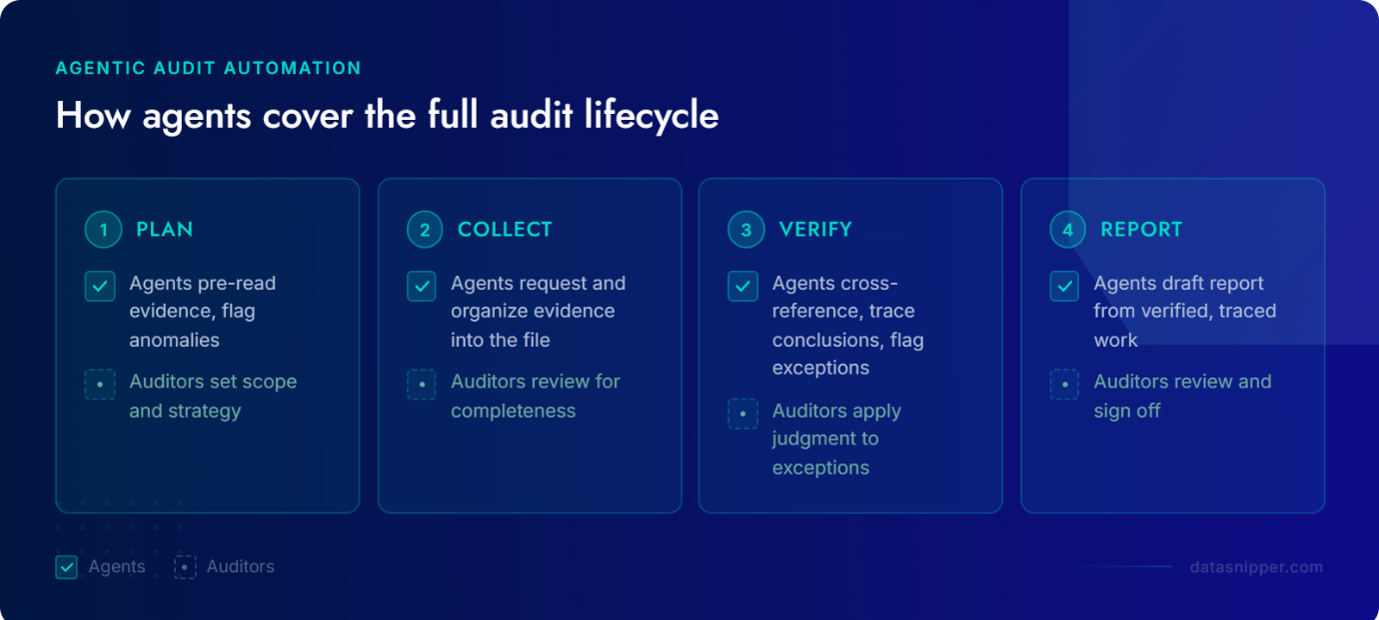
Stage | What agents do | What auditors do |
Plan | Pre-read client evidence, flag anomalies, surface risk areas | Set engagement scope and strategy based on what the file shows |
Collect | Request and organize client evidence directly into the audit file | Review the evidence set for completeness |
Verify | Cross-reference evidence across files, trace conclusions to source, flag exceptions | Apply professional judgment to the overall work performed, including exceptions |
Report | Draft the report substantiated from verified, traced work | Review, adjust, and sign off |
- Plan. Agents pre-read client evidence before the scope is set. They flag anomalies and surface risk areas, so the engagement strategy reflects the actual file rather than assumptions from before anyone looked at it.
- Collect. Agents request and centralize client evidence. Clients submit documents once and agents organize them directly into the audit file. No one manages the PBC list manually.
- Verify. Agents run the testing. They cross-reference evidence across hundreds of files, trace every conclusion to its source, and flag exceptions for the auditor's judgment. The agent identifies the exception. The auditor decides what it means.
- Report. Agents turn verified, traced work into a draft report, substantiated from the start. The engagement manager reviews a file that already holds up, rather than reconstructing the documentation trail after the fact.
Why defensibility drives the design
A platform built for this profession treats traceability as a design requirement. Each conclusion an agent reaches links to the document that supports it. Flagged exceptions stay visible in the workpaper. The auditor inspects the work line by line before signing off.
Where is your firm on its AI journey?
Most firms sit somewhere on a spectrum. Understanding where helps you figure out what the next step looks like.
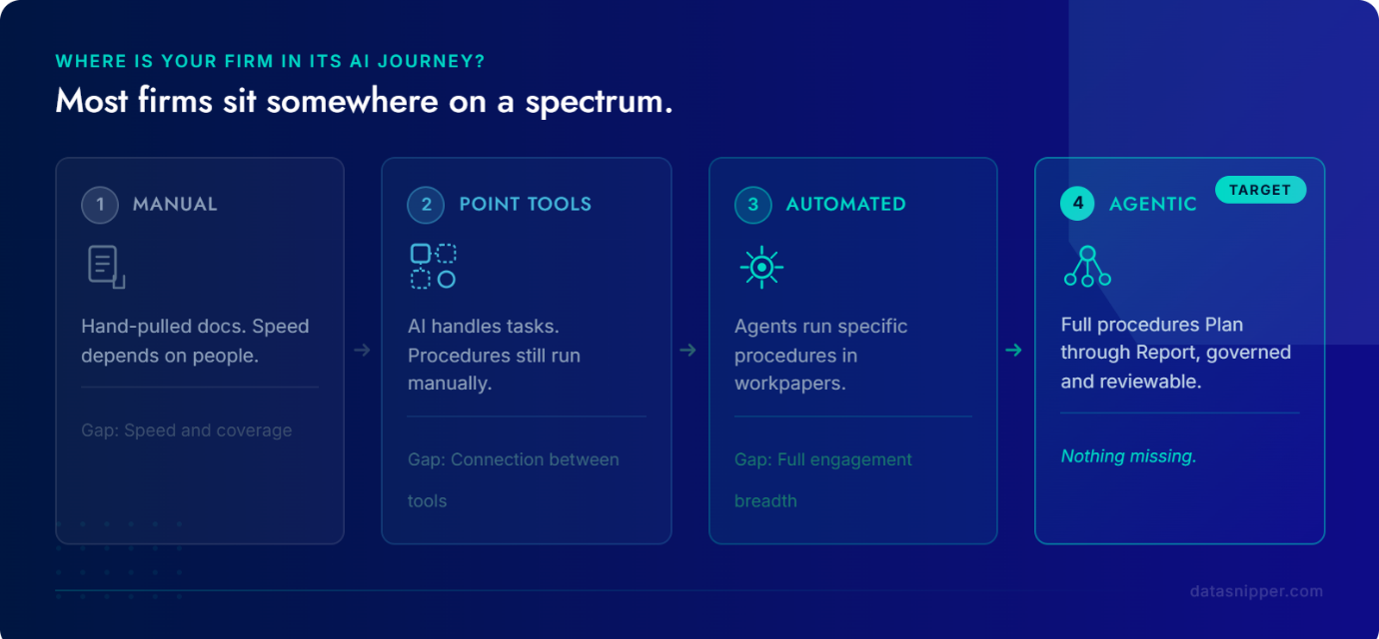
Stage | What it looks like | What is missing |
Manual | First-pass prep done by hand. Preparers spend most of their time pulling and matching documents. | Speed and coverage. Engagement timelines are driven by how fast people can build the file. |
Point tools | AI handles individual tasks: document extraction, search, summarization. Procedures still run manually. | Connection. Each tool does one thing; the engagement still requires a preparer to move the work forward. |
Automated procedures | Agents run specific procedures, such as revenue testing or accounts receivable reconciliation, inside existing workpapers. | Breadth. The platform covers some of the work but not the full engagement lifecycle. |
Agentic platform | Agents run full procedures across the engagement, Plan through Report, governed, versioned, and reviewable by the team. | Nothing. This is the standard the profession is moving toward. |
If your team uses AI to read documents but still assigns a preparer to run each procedure manually, you are in Stage 2. If agents handle specific procedures but the engagement still requires significant manual coordination between steps, you are in Stage 3.
The gap between Stage 3 and Stage 4 is governance and coverage. Stage 4 means agents run end-to-end, the firm controls which agents the team uses and how, and every output is traceable before it reaches the reviewer.
How Alwin by DataSnipper runs end-to-end audit procedures
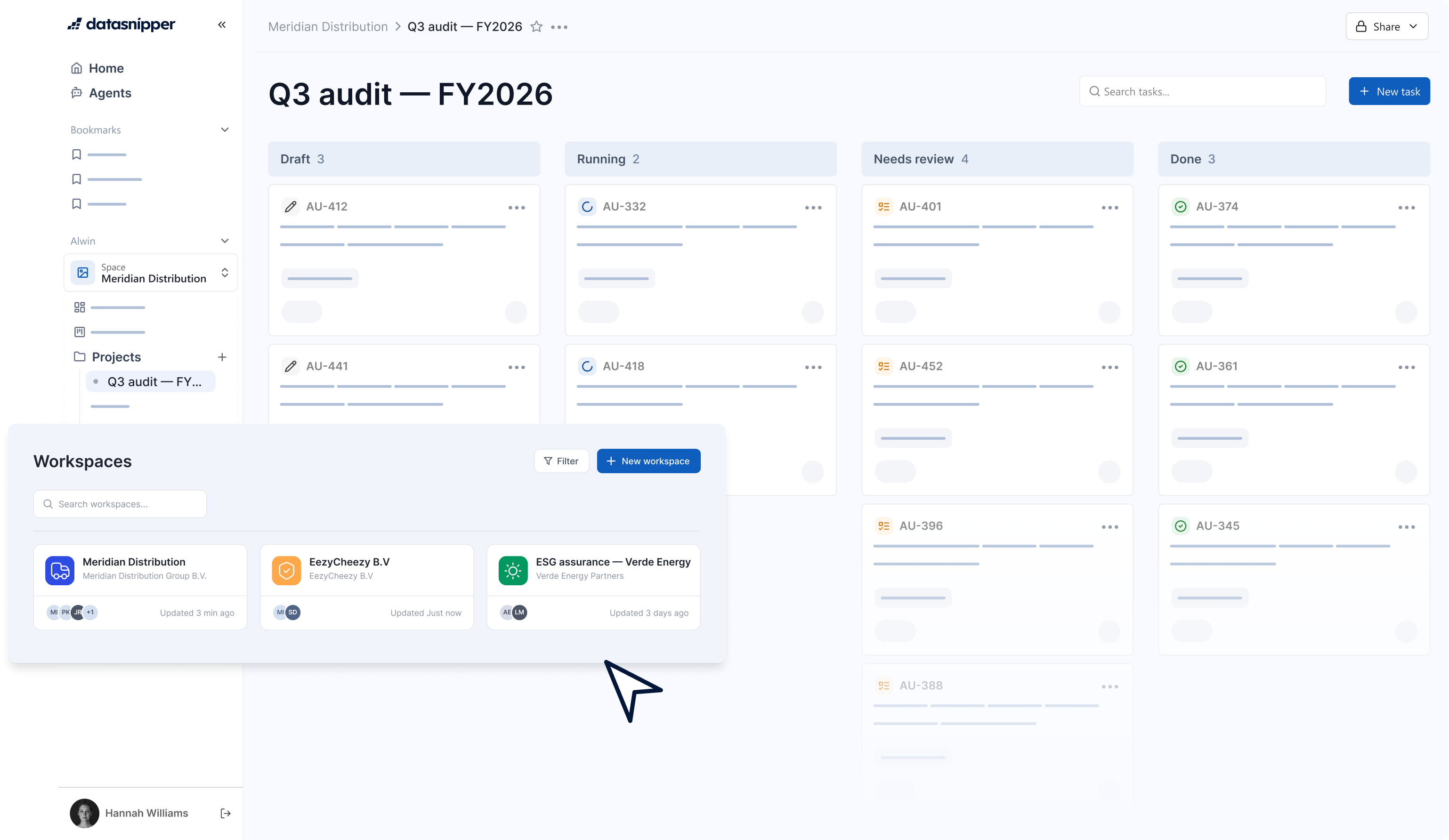
Alwin runs procedures end-to-end, defensibly, on three principles. It executes complete procedures: agents carry multi-step work from planning the right procedures through evidence collection, verification, and reporting, processing hundreds of documents and returning completed workpapers for review.
It makes agentic work defensible: conclusions stay linked to source evidence through Snips, with visibility into agent and human changes and a detailed audit trail to support review. And it governs how agents are used: teams create and share agents through a governed library, with controls over who can access, run, and publish them, plus review gates and checkpoints around how work is executed. Three components deliver that work:
- Agent Library: A catalogue of 50 customizable prebuilt agents covering the procedures audit and finance teams run most, including revenue testing, journal entry testing, and accounts receivable reconciliation. Firms customize agents to match their methodology, version-control them across the organization, and build new ones from any repeatable procedure using the Agent Builder.
- Excel Agents: Agents that run inside the Excel workpapers teams already use. They complete the testing, pull the evidence in, and return a finished workpaper. Teams use the same files they always have.
- Agent Builder: Firms turn their own workflows into custom agents the whole team can run, consistently, and control who builds, runs, and approves them.
Web-based agents: In Alwin, agents run concurrently across large evidence sets, hundreds of files across multiple formats, and hand back a finished workpaper.
Trusted by Fortune 500 companies, government agencies, and all Big Four audit firms, DataSnipper is used by teams across 175+ countries. The platform is PCAOB-aligned, encrypted, and SOC 2 compliant. Client data is never used for model training.
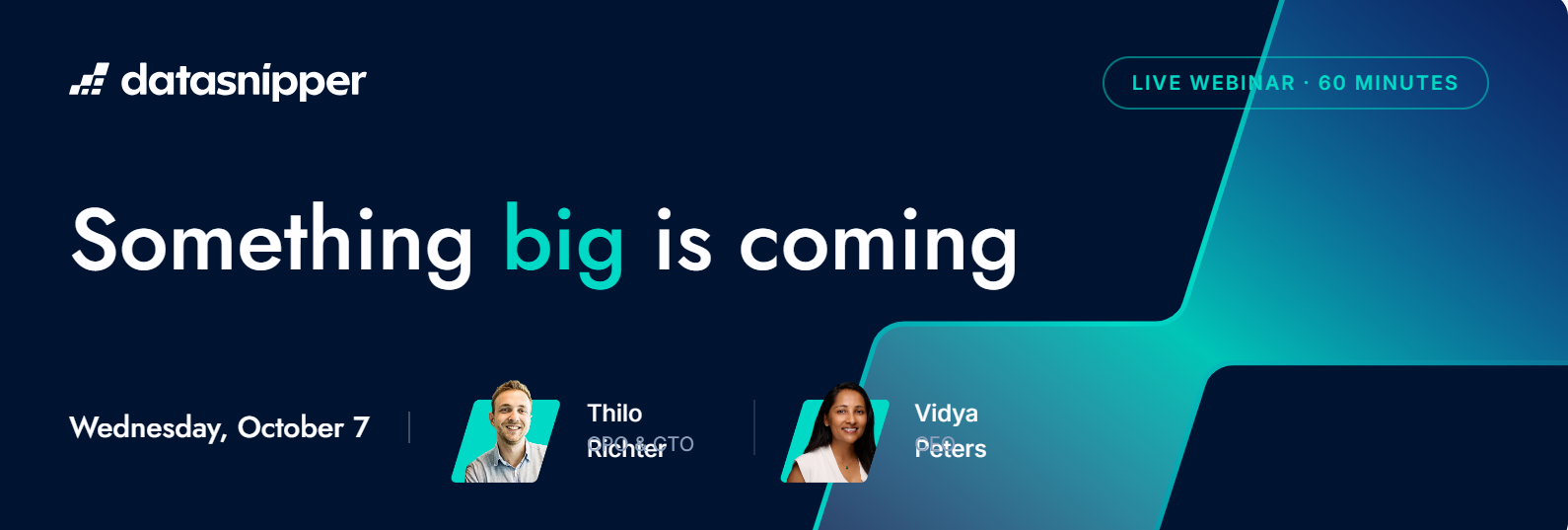
See Alwin run: watch the launch webinar
Auditors provide the trust the world runs on, and that trust rests on four things a good agent can't skip: control, defensibility, governance, and security. That's the work Alwin is focused on. Automating the mundane work, so time can be allocated to tasks that require professional judgement and expertise.
In this session we open up DataSnipper’s take on the future of agentic technology in audit and finance, and show what it looks like in practice: agents running full procedures end-to-end, every conclusion linked back to source evidence, and the auditor still holding the pen. No slideware, no hand-waving on defensibility.
Who is Alwin by DataSnipper designed for
Audit managers running large evidence sets under deadline pressure use Alwin to get to the testing phase faster. Senior auditors who spend more time on first pass prep than on judgment work use it to shift where their hours go. Firm leaders stretched across more engagements than headcount supports use it to cover more without adding staff. Internal audit teams running a controls universe that has grown faster than the team use it to keep up.
Agents run the procedures. Auditors apply the professional judgment and sign the work. Every firm using Alwin still signs every workpaper. They close the engagement faster, with a workpaper that holds up on the first review.
Frequently asked questions
What is an agentic automation platform for audit and finance?
A platform where AI agents execute multi-step audit procedures: requesting evidence, running tests, flagging exceptions. They hand a finished workpaper back to the auditor for review and sign-off. The auditor sets the scope, reviews the output, and signs off. The agent handles the heavy lifting of the procedure.
How is it different from a generic AI tool?
Generic AI tools produce outputs you cannot trace back to the steps and evidence behind them. An agentic audit and finance automation platform ties every conclusion to its source document, so the work holds up under regulatory review. Traceability is the design requirement, built into every output.
Does using Alwin's AI agents mean auditors lose control of the work?
No. Alwin is built so control stays with the auditor. Agents run the procedural work. The auditor reviews what the agent produced, applies professional judgment to exceptions, and signs off. Liability stays with the professional throughout.
Is Alwin PCAOB compliant?
Alwin is PCAOB-aligned. Every conclusion traces to its source, and workpapers are built to meet the documentation standards that inspections require. The platform is also SOC 2 Type II certified and GDPR compliant.
What happens to client data?
Client data is never used for model training. Alwin operates under SOC 2 Type II, GDPR, Standard Contractual Clauses, and the EU-US Data Privacy Framework.
Can firms use their own methodology?
Yes. The Agent Builder lets firms turn their own workflows into custom agents. Prebuilt agents are customizable to match the firm's methodology and are version-controlled across the organization.
How do I know if my firm is ready for an agentic audit automation platform?
If your team runs any repeatable procedure manually every time — revenue testing, journal entry testing, accounts receivable reconciliation — there is a prebuilt agent that covers it. The starting point is usually one procedure, one engagement, reviewed by the senior before it goes anywhere near a sign-off.

.svg?width=600&quality=70&format=auto&crop=16%3A9)